






Penn Medicine Is an Early Adopter of Ambient AI
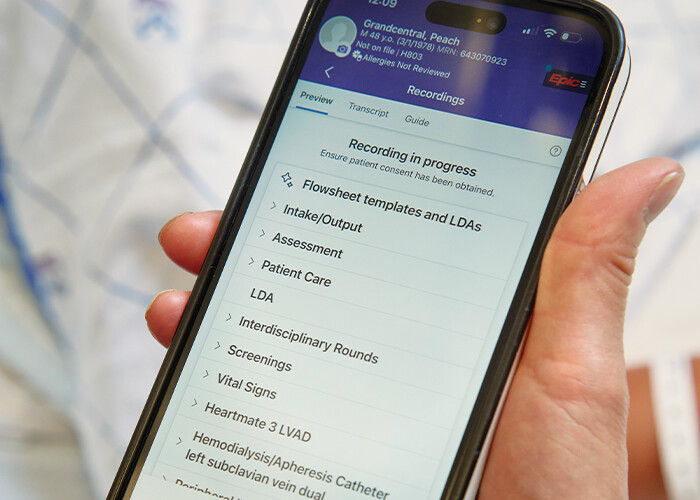
An early adopter of ambient AI through its Penn Sparks innovation program, Philadelphia-based Penn Medicine has developed ambient documentation for approximately 1,300 ambulatory providers and over 600 nurses and is expanding these solutions across physician and nursing teams in ambulatory, inpatient, emergency and home care settings, with full-scale deployment targeted for fall 2026, says Vice President and Chief Digital Applications Officer Anna Schoenbaum.
Future rollouts will include an AI platform for specialty clinicians, and the organization is testing an AI charting solution for Penn Medicine At Home.
Schoenbaum says the data shows a 20% reduction in documentation time, and decreased after-hours documentation for 79% of users, but the qualitative feedback has been equally striking. “We’ve had testimonies from spouses who said, ‘Thanks for giving my wife back, because she’s not going to the computer to work in the evening,’” she adds.
Metrics have also surfaced new questions, including a corresponding increase in orders placed.
“Maybe that means we’re having more thorough conversations with our patients,” Schoenbaum says. “We’re trying to understand what’s driving that.”
READ MORE: Clinical workflow optimization creates better patient outcomes.
Penn Medicine recently rolled out ambient AI to approximately 550 inpatient nurses and 80 nurses in ambulatory. Early results show reductions in documentation latency and time spent in the electronic health record (EHR) system. In ambulatory settings, Penn Medicine is working with a vendor partner to integrate ambient AI into nurse triage workflows. When triage nurses encountered friction with a new nurse triage module, Schoenbaum introduced ambient AI as an alternative approach, despite the initial concern that the platform was not designed for that use case.
“We tried it, and it is clunky, but the nurses love it. So, we’re fine-tuning that, and hopefully, we’ll have that in production soon,” she says.
The work reflects a broader shift toward rethinking how technology enables care delivery, focused on practical innovation that reduces friction and supports clinicians in reimagining workflows across settings, says Schoenbaum.
Penn Medicine continues to study patients’ experience with AI scribes and plans to keep scaling into other disciplines.
“This is just the beginning, but it’s exciting that we finally have a technology that can bring a spark back into people’s workflow,” Schoenbaum says. “It’s about collaboration, as the implementation and support require a team of clinicians and experts in operations, data science, ethics, privacy, security, infrastructure and informatics, and we need everybody to make sure we’re doing it right.”