




Close

New Workspace Modernization Research from CDW

See how IT leaders are tackling workspace modernization opportunities and challenges.

Feb 27 2026
Management

ViVE 2026: The Federal Policies and Priorities Shaping Healthcare IT

The Rural Health Transformation Program and other federal initiatives took center stage at the annual conference.

The landscape for federal healthcare funding is shifting, to say the least, from the reduction of research grants awarded through the National Institutes of Health to the upcoming cuts to federal Medicaid spending and the planned $50 billion Rural Health Transformation Program

For healthcare IT leaders, that means being in organizational lockstep as traditionally tight budgets get even tighter, finding opportunities to optimize costs while still allowing for innovation, and refining the use cases for automation to improve workflows

During the 2026 ViVE conference in Los Angeles, there was a core focus on federal guidance through this era of change.

Click the banner to learn how a partner can help independent hospitals solve IT challenges.


Dr. Thomas Keane, assistant secretary for technology policy and national coordinator for Health IT (which is under the U.S. Department of Health and Human Services), discussed priorities from his office on Tuesday, centered around interoperability and data access. 

At the top of the list was “fostering greater data liquidity in the healthcare system”: if consumers can easily track their restaurant order through a food delivery app, patients and providers alike should not be so burdened in tracking down health records. 

MORE FROM ViVE 2026: Change management is key in the clinical adoption of AI.

“The bar for healthcare data should be at least as high as getting the food picked up at the right curb,” Keane said. “Modern data standards and artificial intelligence will make healthcare more affordable, more accessible and support improved health outcomes.” 

He then highlighted new and proposed rules, including opening up access to real-time drug prescription information to allow for price comparisons, and a proposal to deregulate some health IT standards that has just recently reached the end of its comment period. He stressed the importance of adopting HL7 Fast Healthcare Interoperability Resources–based application programming interface requirements and lauded the Trusted Exchange Framework and Common Agreement as the right path to allow patients to manage their records in one place.

Last fall, HHS announced that it would take stricter enforcement against information blocking, opening up a complaint portal for reporting. Keane emphasized once more that patients should have access to their data and neither healthcare providers nor the vendors of electronic health records systems should be allowed “to hoard health information for their own benefit.” 

On the adoption of AI in the industry, Keane said the federal approach would be to foster a “try-first culture,” encouraging more deployments of emerging solutions. He added that HHS will be shaping policy through regulation, reimbursement, and research and development. His office had also sought public input on how the industry can “accelerate AI adoption, how AI can improve patient and caregiver experiences, reduce provider burden, improve quality of care and lower costs for consumers and governments alike.” 

Elsewhere in the conference, there were robust discussions about the Rural Health Transformation Program and what the new funding mechanism could mean for rural providers.

Lt. Cmdr. Michael Banyas, Emily Chen, Dr. Halima Ahmadi-Montecalvo and Dr. Dave Newman
(From left to right) Lt. Cmdr. Michael Banyas, Senior Officer in the U.S. Public Health Service and a Health Specialist in the National Institute of Minority Health Disparities, moderates a discussion on the Rural Health Transformation Program. Emily Chen, Senior Advisor in the Office of the Administrator at the Centers for Medicare and Medicaid Services; Dr. Halima Ahmadi-Montecalvo, Vice President of research and Evaluation at Unite Us; and Dr. Dave Newman, Chief Medical Officer of Virtual Care at Sanford Health, listen on at the 2026 ViVE conference in Los Angeles on Monday, Feb. 23, 2026. (Photo Courtesy of ViVE)
 

More Clarity on the Rural Health Transformation Program

Emily Chen, a senior adviser in the Office of the Administrator in the Centers for Medicare and Medicaid Services, led the creation of the Rural Health Transformation Program. During a panel discussion Monday, she highlighted the strategic goals of the program meant to award $50 billion, or $10 billion per year over five years, to the states to promote preventive care, improve care access, develop a local workforce, innovate care delivery and strengthen tech implementation. 

She stressed that the program is meant to support change in rural healthcare. “It's not meant to perpetuate the status quo or replace existing reimbursement pathways. It’s meant to truly fund initiatives that are transformative,” she said. 

She highlighted the sustainability of projects so that they don’t hit a funding cliff in five years. 

“For example, modifying or replacing existing clinical service fee schedules is an unallowable use of funds. There are many other ways to support providers and facilities. You can do alternative payment models that tie to outcomes. You can fund physician recruitment and retention programs. You can invest in facility technology and infrastructure, just to name a couple,” Chen said. “Another guardrail is that it is capped in terms of the amount of funding that you can use to completely replace an EHR system if it's already HITECH-certified. However, there is no cap on upgrades, enhancements or additional modules.” 

OTHER ViVE COVERAGE: How to foster a tech-empowered workforce in healthcare.

There is a dedicated team of 30 full-time employees overseeing this program, which has already received applications and disbursed allocations to states as of December 2025, Chen added. The states are the driving force behind which initiatives they end up choosing, but CMS will have oversight. 

Dr. Dave Newman, chief medical officer of virtual care at Sioux Falls, S.D.-based Sanford Health, was enthusiastic about the program. As an endocrinologist who grew up in Fargo, N.D, he saw his dad ski cross-country to get to the hospital after a blizzard to see patients. 

“That's the dedication that we have to take care of our patients in rural America. I lived that growing up and I live that now. My motivation for still serving my patients in rural North Dakota and South Dakota is to make their lives better. And, I'm telling you, the patients are good at stuff. The doctors are good at stuff,” he said, adding that the program will help “make us scale and get better at the things we're already good at.”

Click the banner below to explore how healthcare organizations can take advantage of data and AI.


Dr. Halima Ahmadi-Montecalvo, vice president of research and evaluation at software company Unite Us, who did her postgraduate training in West Virginia, noted that while rural healthcare is often viewed through a lens of what it lacks, communities are much more capable than they’re given credit for. “I saw resilience; I saw these tight-knit, social networks; I saw leaders who were really deeply committed to their communities. So, the challenge is not capability; it really is about alignment,” she said. 

She was hopeful that the program could better address social determinants of health and better connect providers to community-based support such as housing agencies and food banks so that all elements work together for an integrated care pathway. 

Newman also touted opportunities for workforce development and connecting rural communities to specialty care.

“Do you guys think it's easy to recruit a pediatric endocrinologist to a small town in North Dakota? I'm telling you, it's not going to happen. What I can do is I can recruit one pediatric endocrinologist to live in either Fargo or Sioux Falls, or any place across the country, and I can upskill the nurses in small towns. I can upskill them to use the technology to download continuous glucose monitors, and I can deliver care virtually so the subspecialists can deliver care where the patient wants it,” he said. “That is absolutely the future of what we're going to be doing in rural America. Just because you live in a ZIP code that doesn't have a subspecialist, doesn't mean we can't deliver subspecialist care to that ZIP code.” 

DIVE DEEPER: How Nemours Children’s Health is expanding pediatric care at home.

Chen shared that in Delaware’s application, the state included a proposal to establish its first four-year medical school dedicated to fostering a clinical workforce for rural health. 

“If you grew up, if you studied, if you trained in an area, you're more likely to stay there and build your career there, right? And so, a lot of states focused on this theme, several of them focused on high school-to-healthcare career pathway programs,” Chen said. 

Newman was optimistic about the potential positive impact of the Rural Health Transformation Program.

“We have made healthcare so complicated, so hard to achieve care, but for the first time in my life, I actually think it's getting better because of us trying something different,” Newman said. “Healthcare doesn't need to be bricks and mortar. Healthcare doesn't need to be fee for service. Healthcare doesn't need to be traditional pharmacal therapies. We can do things better by leveraging technology and meeting patients where they want to receive care.”

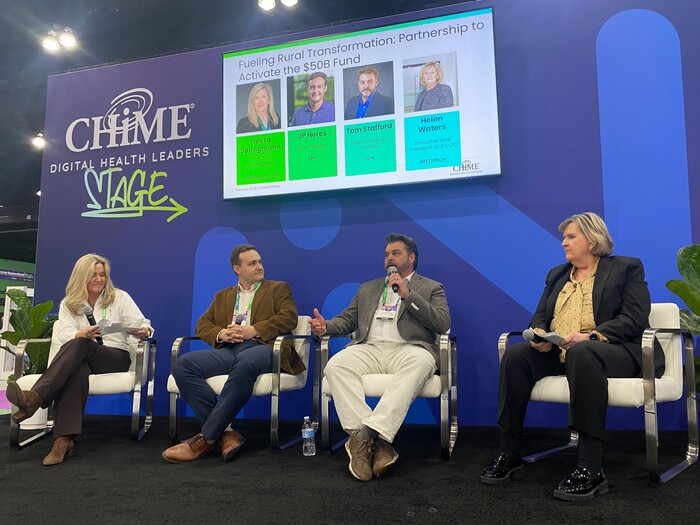
Tressa Springmann, JP Heres, Tom Stafford and Helen Waters
(From left to right) Tressa Springmann, Senior Vice President and Chief Information and Digital Officer at LifeBridge Health, moderates a discussion with JP Heres, Vice President of Garden Plot at Epic; Tom Stafford, Director of Healthcare Strategy at CDW Healthcare; and Helen Waters, Executive Vice President and COO at MEDITECH. (Photography by Teta Alim)
 

Industry Partnerships to Support Rural Healthcare Providers

During a separate discussion about the new rural health funding mechanism, leaders from industry partners Epic, CDW and MEDITECH shared how more thoughtful collaboration will better support providers as they adjust to the program. 

Tom Stafford, director of healthcare strategy at CDW Healthcare and a former healthcare CIO with rural experience, understood how resource-stretched these organizations are. 

“Small hospitals get things done, but they also have this thing called ‘STP’: The ‘same three people’ do all the work, right?” Stafford said. “We've all been there, and so I guess the partnership I'm talking about is a little different — providers within the state need to partner together because they have the same application and will get the same service from that state. So, it's important to talk to your friends across the state, down the state, and band together to make sure you're getting what you deserve to get out of the $50 billion.” 

JP Heres, vice president of Garden Plot at Epic, had a bright outlook on the program, focusing on technological improvements as foundational to care relationships. 

“I think AI is a workforce extender in rural settings,” he said, adding that the expansion of virtual care services will also continue to transform care models. 

LEARN MORE: Rural healthcare navigates uncertainty amid budgetary concerns.

“Tech in and of itself won't fix these problems, but tech absolutely can be a driver if the money is appropriately apportioned to the facilities,” added Helen Waters, executive vice president and COO at MEDITECH. 

Stafford also highlighted the work CDW has done to support rural healthcare providers, including partnerships with Starlink to enable reliable connectivity, supporting Microsoft with its security assessment that’s available for rural and community hospitals, working with Cisco on other security-focused deployments, and offering agentic AI workshops for critical access hospitals, helping with Microsoft Copilot and Copilot Studio to make change. 

“We have the right tools to keep these hospitals thriving and not just surviving,” Stafford said. “It's a community. People stay in that community, and that health system is part of the community. It would be a shame if they all start disappearing, so we're here to help.”

Photo Courtesy of ViVE