





Close

New Workspace Modernization Research from CDW

See how IT leaders are tackling workspace modernization opportunities and challenges.

Feb 19 2026
Artificial Intelligence

How Health Systems Reduce the Strain of Documentation Burden

Providers know that this is one of their most persistent challenges. Artificial intelligence and cloud computing may offer needed relief.

City of Hope is a leader in cancer treatment and research, with facilities in Southern California, Phoenix, Chicago and Atlanta. In 2024, it onboarded more than 150,000 new patients across those locations, many of whom arrived with advanced cancers and lengthy medical histories that physicians needed to review.

Historically, those reviews have been a major pain point, says Chief Artificial Intelligence Officer Nasim Eftekhari.

“At a scale of 150,000 patients, imagine how many lost hours that is for our clinicians,” she says. “A lot of times, they’d do this during what we call ‘pajama time,’ in the evening or very early in the morning.”

Eftekhari and Chief Digital and Technology Officer Simon Nazarian saw an opportunity to change that. Their teams built an agentic large language model platform in the cloud, HopeLLM, which orchestrates several in-house, open-source and commercial models into various applications. One of them uses generative AI and other capabilities to create concise summaries of medical histories, which physicians can query using natural language.

“This gives us the ability to not only support our doctors but also increase their time with patients and their ability to see more patients,” Nazarian says.

Documentation burden remains a major issue for healthcare providers, but there is optimism that cloud computing and AI may significantly reduce it. Organizations across the U.S. are leveraging public cloud scalability, security and AI models to minimize manual processes in a variety of documentation areas.

Click the banner below to read the new CDW Artificial Intelligence Research Report.


How City of Hope Eases Documentation Burden

When City of Hope physicians, intake nurses and other users use HopeLLM to create a medical history summary, they can see in a matter of minutes a synopsis and timeline of key events, treatments and other important information, Eftekhari says.

“We also have topical summaries if they want to dig deeper into areas such as radiology, pathology, even psychology and socioeconomic factors — anything where they need to know more,” she says.

HopeLLM’s ease of use (for instance, letting physicians ask questions about medical records in natural language) makes it equally beneficial for patients at the point of care, Nazarian says.

“Instead of the doctor typing or going through papers, they can actually look their patients in the eye and have a conversation, using HopeLLM like an assistant,” Eftekhari says. “We built this to help the clinicians, but when it went live, the patients also loved it, which is fantastic.”

While the team developed the first iteration of HopeLLM relatively quickly, Eftekhari says that was possible only because City of Hope had been on its AI journey for about a decade.

“We had a really good foundation that we’ve been working on for years, so we were able to take these foundational models and use them as parts of the puzzle to bring the first minimum viable product to life,” she says.

HopeLLM uses agentic AI for advanced capabilities such as writing SQL queries automatically and comparing cancer treatments to National Comprehensive Cancer Network guidelines. Working in the cloud provided not only the necessary computing power but also elasticity and access to AI models.

“HopeLLM is the epitome of fantastic agentic AI orchestration,” Nazarian says. “It’s one of the things that people are striving to do, and we’ve done it here.”

READ MORE: Healthcare IT leaders get real on the state of AI in 2026.

Providence Finds Clarity With Patient Messaging

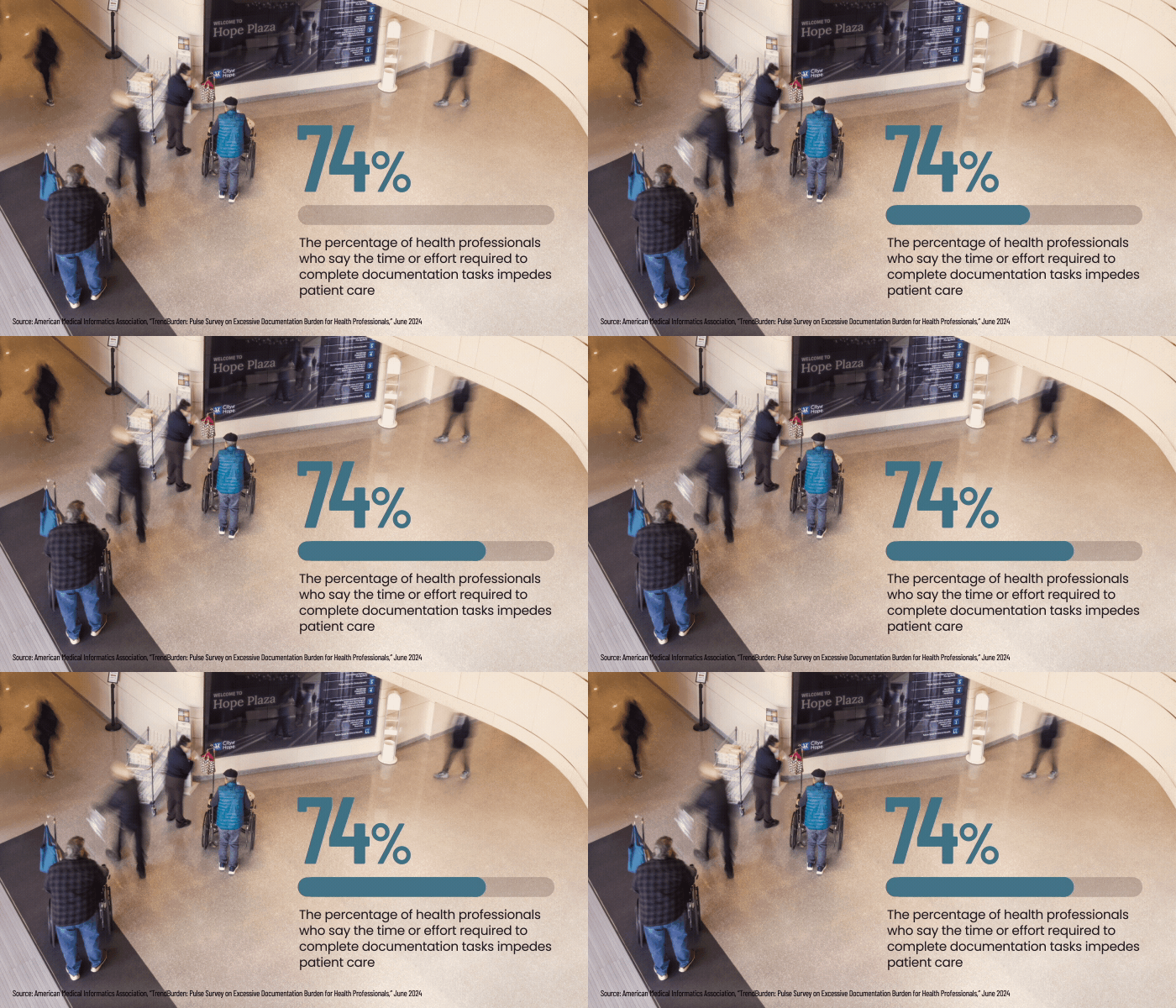
For many providers, responding to patient emails is an ever-increasing workload, from answering routine inquiries to providing medical advice about symptoms. Renton, Wash.-based Providence reached a turning point in late 2022, when emails in Epic MyChart surpassed phone calls as the primary means of communication from patients.

“The in-basket has almost become a new site of care,” says Dr. Ford Parsons, chief medical information officer for AI and engineering.

With 51 hospitals and more than 1,000 clinics, Providence’s increase in messages slowed turnaround time, and caregivers struggled to prioritize urgent requests because they handled messages as they arrived, Parsons says.

“That made us identify an operational — almost clinical — need to come up with a new and better way to help our caregivers respond to patient messages,” he says.

With existing workloads in Microsoft Azure, Parsons says, it made sense to build an advanced natural language processing engine in Azure using OpenAI’s GPT architecture to categorize messages by content and urgency and delegate them to the appropriate group. The cloud’s secure, reliable infrastructure and developer-friendly tools made Azure a good fit and let the team iterate rapidly, he adds.

healthcare stat


Clinicians’ input ensured that the final product, named Provaria, would actually improve their workflow, Parsons says.

“We talk all the time about caregivers working at the top of their license. We don’t want doctors answering questions about what time the clinic is open, and we don’t want medical assistants recommending medications,” Parsons says. “These categories allow caregivers to self-select the messages they’re uniquely qualified to respond to.”

Provaria empowers nurses and medical assistants to handle more messages independently without needing doctors’ input. It’s also decreased the response time for symptom-related messages by nearly half.

“Nurses are able to find those needles in the haystack and handle them right away,” Parsons says. “Now, we can call those patients to say, ‘We’ve got an opening this afternoon. Do you want to come in?’”

Alongside messages, Provaria also provides category-specific workflow guidance that draws from a relevant clinical knowledge base. In the past, users would have had to track down that documentation, so Provaria saves time while reinforcing best practices.

One unexpected benefit is greater peace of mind for caregivers, who no longer worry about missing urgent messages, Parsons says. For him, that’s just one way AI and other technologies can support clinicians.

“Our doctors and nurses are best at providing empathetic care at the bedside,” Parsons says. “I want to empower them to do what comes naturally to them by using AI to sort out all this other stuff.”

Heartland Dental Turns to the Cloud

Heartland Dental, a national dental support organization, has built its data strategy around cloud solutions, including a strategic pairing of SAP and Google Cloud, says Senior Vice President and Chief Digital Officer Robert Jerome. In addition to helping dentists establish their practices, the Effingham, Ill.-headquartered organization provides data insights to help it optimize operations.

Since 2018, cloud-based tools have enabled the organization to deepen that support; for example, by scaling analytics capabilities through SAP’s Business Technology Platform, using Google Cloud’s BigQuery analytics platform and building generative AI tools with Google Vertex AI.

“When Google started deepening its partnership with SAP, our perspective was that this is going to be stronger together,” Jerome says. “Google doesn’t replace SAP; it complements it.”

As a technology leader, working within the cloud gives Jerome speed and agility without compromising cybersecurity. The cloud also provides the computing power and the tools for Heartland Dental to develop custom AI applications. One of the most effective initiatives used Google’s Gemini Pro and Vertex AI to develop an AI chat agent for supported dental practices’ business assistants.

EXPLORE: These are the four cloud tech trends to watch in 2026.

BAs are front-office staffers who are often new to dentistry, so there’s a steep learning curve to their role. In the past, when BAs had questions about a workflow, they had to sort through lengthy playbooks and operations manuals to find the information they needed, Jerome says.

Now, they simply ask the chat agent. “Anything related to accounts receivable or operations, they just ask, and it gives them the answer,” he says. “If you’re new to the job, that’s huge.”

The AI agent is integrated into Heartbeat Engage, an SAP platform that consolidates dozens of applications in a single interface. The platform automates BAs’ work queues and streamlines day-to-day tasks by making it easy to access critical resources, Jerome says.

“The office staff love it because everything’s in one place,” he says.

Click the banner below to sign up for HealthTech’s weekly newsletter.


Returning the Joy to Practicing Medicine

The cloud’s scalability sets the stage for the ongoing implementation of solutions designed to address documentation burden. Heartland Dental is evaluating ambient listening and other AI tools that prepare clinical narratives for review, a deployment that Jerome says will ease documentation and improve revenue cycle management. Providence has incorporated transcribed phone messages into Provaria and continues to scale across additional clinics and specialties.

City of Hope is rolling out HopeLLM’s clinical trial matching application, which has the potential to make a dramatic difference for patients and researchers.

“That one is so tangible and lifesaving that I’m very excited about it,” Eftekhari says. “It’s been in pilot for almost a year, and we are seeing excellent results.”

So far, HopeLLM has already helped physicians reduce the pajama time required to onboard new patients. While reducing time spent on tasks from hours to minutes is significant, the qualitative impact is the biggest reward, Eftekhari says: “One doctor told us, ‘This has given me back the joy of practicing medicine.’”

Photography by Christina Gandolfo