




Close

New Workspace Modernization Research from CDW

See how IT leaders are tackling workspace modernization opportunities and challenges.

Feb 17 2026
Patient-Centered Care

Q&A: Catholic Health’s New Patient Care Pavilion Aims To Improve Clinical Workflows

Catholic Health Chief Digital and Information Officer Michael Mainiero discusses the importance of a new facility to reduce clinical pain points.

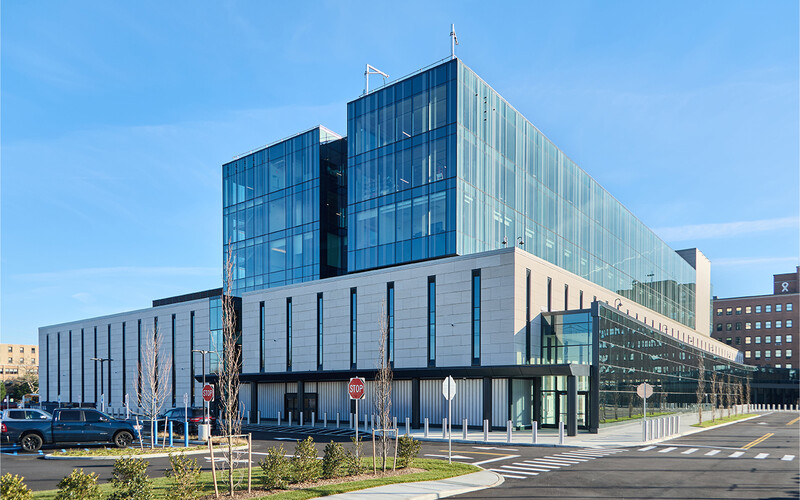
Catholic Health’s Good Samaritan University Hospital closed out 2025 by welcoming the community to its brand-new Patient Care Pavilion.

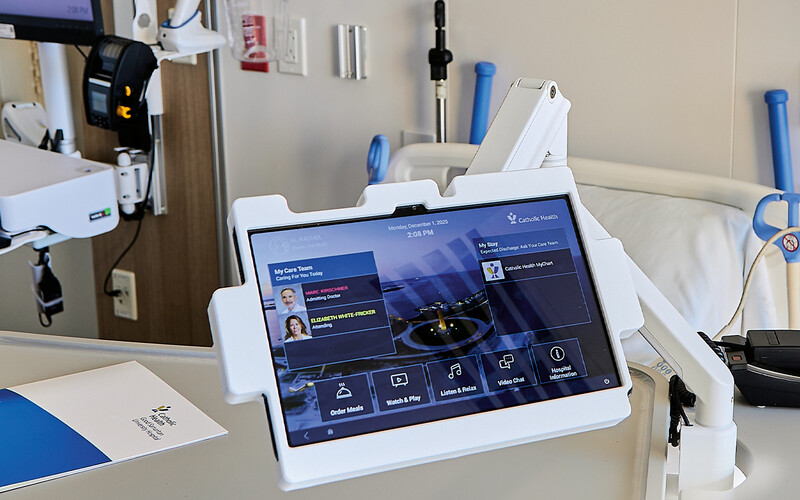
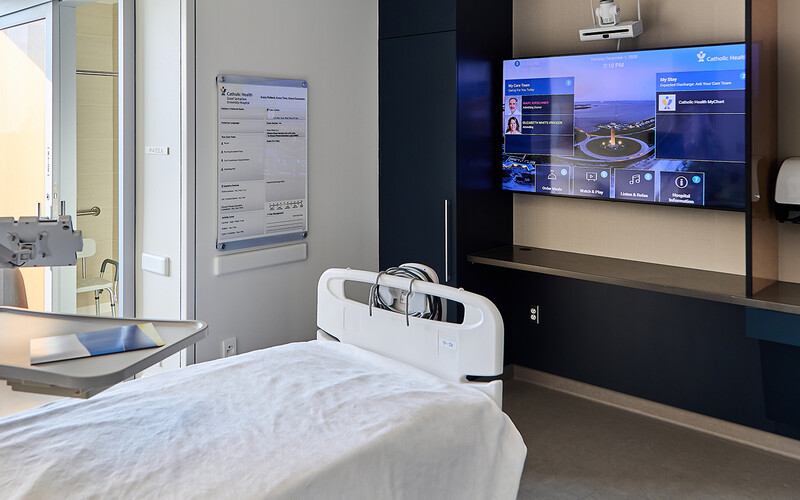
The 300,000-square-foot facility in West Islip, N.Y., located on Long Island’s South Shore, includes a new emergency department, advanced operating rooms and modern patient rooms outfitted with smart TVs and tablet devices integrated with virtual nursing capabilities.

Chief Digital and Information Officer Michael Mainiero offers insights into how the health system transformed to provide a more frictionless experience for clinicians and patients.

DISCOVER: These are the four trends to watch in 2026 as workplace technology evolves.

HEALTHTECH: How did Catholic Health decide on what technologies would be present in the new facility? Why was it important to have these specific integrations?

I came to Catholic Health just under four years ago, which was after planning and design. When I came on, the CEO wanted to make sure that I was bringing the best technology into the patient care setting. We don’t want technology looking for a problem. We want to bring in things that hopefully remove friction from either the clinician or patient experience. We wanted to match the technology with problem statements and take away things that might be onerous. We want clinicians to focus on care. We want them to take care of the patients, not deal with administrative burden or things that might take them away from high-quality, high-touch with the patient. Whether it be fewer clicks, faster communication or automating tasks that can free up time, everything was built with that in mind. We wanted to provide the best patient experience, the best clinician experience and outcomes.

Click the banner below to read CDW’s new research report on optimizing modern work.


HEALTHTECH: How did you get buy-in from leadership and end users? How are you ensuring that the technology is going to be used and not just worked around?

It’s about responding to the staffing reality. One of the technologies that we’re bringing in is virtual nursing with ambient artificial intelligence. Our focus has been on how to reduce burnout, how to reduce the burden that's put on the clinicians. On the patient side, we’ve brought on a platform called OneView that is a digital hub for entertainment, meal ordering, translation services and more, so that patients and their loved ones have everything at their fingertips. It also has patient education, things like that, which really helps the care team. That way, patients are relaxed, and they can handle simple things such as meal ordering through a screen rather than calling down to the cafeteria.

Getting buy-in was straightforward because we’re not building the pavilion around the technology, we’re building it to address pain points identified by the clinicians: call burdens, alarms and workflow interruptions. We then tested the systems and showed their use in other settings. When clinicians see that their time has been returned to them, they’re interested, and they want to be involved in adopting this technology.

HEALTHTECH: How do you find that balance of meeting patient and care team expectations? Because they don’t always match, how are you addressing that some things work for clinicians and some work for patients?

The clinicians shape the workflows. So, for example, with virtual nursing, it’s not enough to just put a camera in a patient room and call it a day. Clinicians dictate the workflows. Are we offloading tasks so that the nurses on the floor can focus on care while the remote team member handles the admissions process? Does that include discharge? Solving that workflow not only improves it for the clinician but also for the patient.

The digital patient hub allows patients to be more engaged in their care. If they already see that they have a radiology appointment at 2 p.m., they don’t have to ask a nurse or another care team member those kinds of redundant questions. Whenever you can solve for both sides of the equation — for both clinician and patient — you're going to win. Hopefully, we reduce the noise, the interruptions and any hand-off errors, and give patients more control. We think a lot about that patient experience; sometimes, when you’re in the hands of a hospital and care team, you may feel like you don’t have a lot of control. In these rooms, you can at least better understand your treatment and know who is on your care team. These are seemingly very simple things, but they're profound when you're a patient in that bed.
 

HEALTHTECH: Although the pavilion has just opened, how will your organization measure its success? What are some other expected outcomes, and how will you respond to feedback?

One of the biggest measures will be time: How much time can I give the nurse back? Have we lessened pain points so that clinicians can operate at the top of their license? Has adopting 24/7 ambient technology reduced the instances of unwitnessed events that lead to harm? We can look at nursing documentation time, we can look at mission discharge time, we can look at fall rates, we can look at the call light volume.

When we evaluate our digital hub platform, we can look at patient engagement and see if they’re completing their education. We can review our patient engagement scores from Press Ganey. We want to see improvements in how patients are communicating with their care team. All of these involve continuous feedback loops with the units, so nothing stays static.

RELATED: How are smart hospitals pushing forward from pilot to practice?

HEALTHTECH: What advice do you have for other healthcare organizations who may need to upgrade their facilities? Where can they start?

Start with staffing realities. Choose tech that gives back time, not tech that adds steps. If I'm dealing with something stressful, such as going to the airport but my taxi is late, I get frustrated. Think about the nurses’ experience. They’re in charge of caring for people who may be in seriously acute conditions, but they have to waste time clicking onto a platform. You don't want tech that adds steps or burden. It has to fit into their workflow.

Next, build smart room standards early. Don't try to retrofit placement for sensors, cabling and cameras. That's costly. When you’re building a new pavilion, you can’t drill or fill things in later. In some instances, we're putting things in that we're not turning on, but they're in place. So, it doesn't need to be running on day one. I think a lot of health systems get hung up on having everything go live the first day. You don't necessarily need everything to be live. You just need it to be in place.

Thirdly, it’s key to select platforms that integrate with the electronic health record system and can scale. Try to avoid point solutions. Our digital hub for patients integrates with Epic. If it didn’t, it would be just another point solution that operates independent of the EHR. So, integrating with other systems is probably the most important aspect of selecting technology. Virtual nursing also integrates with our EHR; if it didn’t, it would have been a nonstarter. Also, bring in the front-line staff to test things as soon as possible. Make sure they have demos. They'll see what the vendors miss. They'll see what the technology misses. Bring them in early, and pilot if you can. That will improve the workload you have.

Finally, have real empathy for what the nurses’ or the physicians’ needs are. There's a lot of hype around tech and AI right now, so be thoughtful and deliberate about what you select. Reach out to other health systems and see what they've done, what worked and what didn't.

Photography by Gabriela Herman