



Close

New Workspace Modernization Research from CDW

See how IT leaders are tackling workspace modernization opportunities and challenges.

Feb 18 2026
Security

Protecting a Healthcare Facility From All Angles

Workplace violence is a major concern in healthcare. Organizations may need a multilayered approach to better protect their team members.

Earlier in her career as a practicing physician, Jacqueline Naeem saw patients full time. For the most part, she says, she enjoyed her clinical work, but there were times when an appointment didn’t go as smoothly as planned, to the point that she feared for her safety.

“Sometimes, when you see a patient and you haven’t had time to read their entire history, you don’t know what to expect,” she says, and that can be serious worry for clinicians.

Today, as vice president of clinical and social health at Parkland Center for Clinical Innovation (PCCI), Naeem doesn’t work directly with patients nearly as often as she used to. At the analytics, research and development organization, an affiliate of Parkland Health in Dallas, she spends most days collaborating with data scientists to develop innovative solutions for challenging health and community problems. She’s often working on one product in particular: a predictive tool to assess whether any given patient poses a threat to clinicians.

Click the banner below to enhance your health system’s physical security program.


Similar to a clinical decision support system and used only in inpatient settings, the solution is built on an IT model that runs on data from electronic health records, nonmedical social determinants of health and other factors, which are then analyzed to generate a probability score of zero to 100%. The model first runs when a patient is admitted, and it’s updated throughout the stay whenever new data is added. If a patient’s score hits a predetermined threshold, clinicians are alerted via the EHR when they log in to the system.

Then, based on that information, a clinician may decide whether an intervention is advisable.

“You could do nothing if you think that’s the right approach, or you could choose to bring in an extra member of the staff or do an extra assessment,” Naeem says. “It’s not something that tells you what to do, but it does help you to be more aware.”

Rethinking Physical Security in High-Risk Healthcare Environments

Health systems regularly evaluate their physical security because of the high risk of workplace violence. Healthcare workers are five times more likely to experience violence than employees in other industries, according to the U.S. Bureau of Labor Statistics, accounting for nearly 75% of the country’s annual nonfatal violence-related workplace injuries and illnesses.

“Most people have no idea how often nurses are assaulted,” says Scott Gee, deputy national adviser for cybersecurity and risk at the American Hospital Association, which estimates that the total financial cost of violence to U.S. hospitals tops $18 billion per year.

“Physical security is a serious problem for healthcare, and unfortunately, there’s no magic solution,” Gee says.

Some hospitals may install weapons detection systems at their main entrances and rely on advanced video surveillance for campus monitoring, but those solutions aren’t effective without trained staff who can quickly respond to alerts. Access control technologies such as key cards and fobs can prevent people from entering areas they shouldn’t, but these also require employee training and adherence to specific security policies.
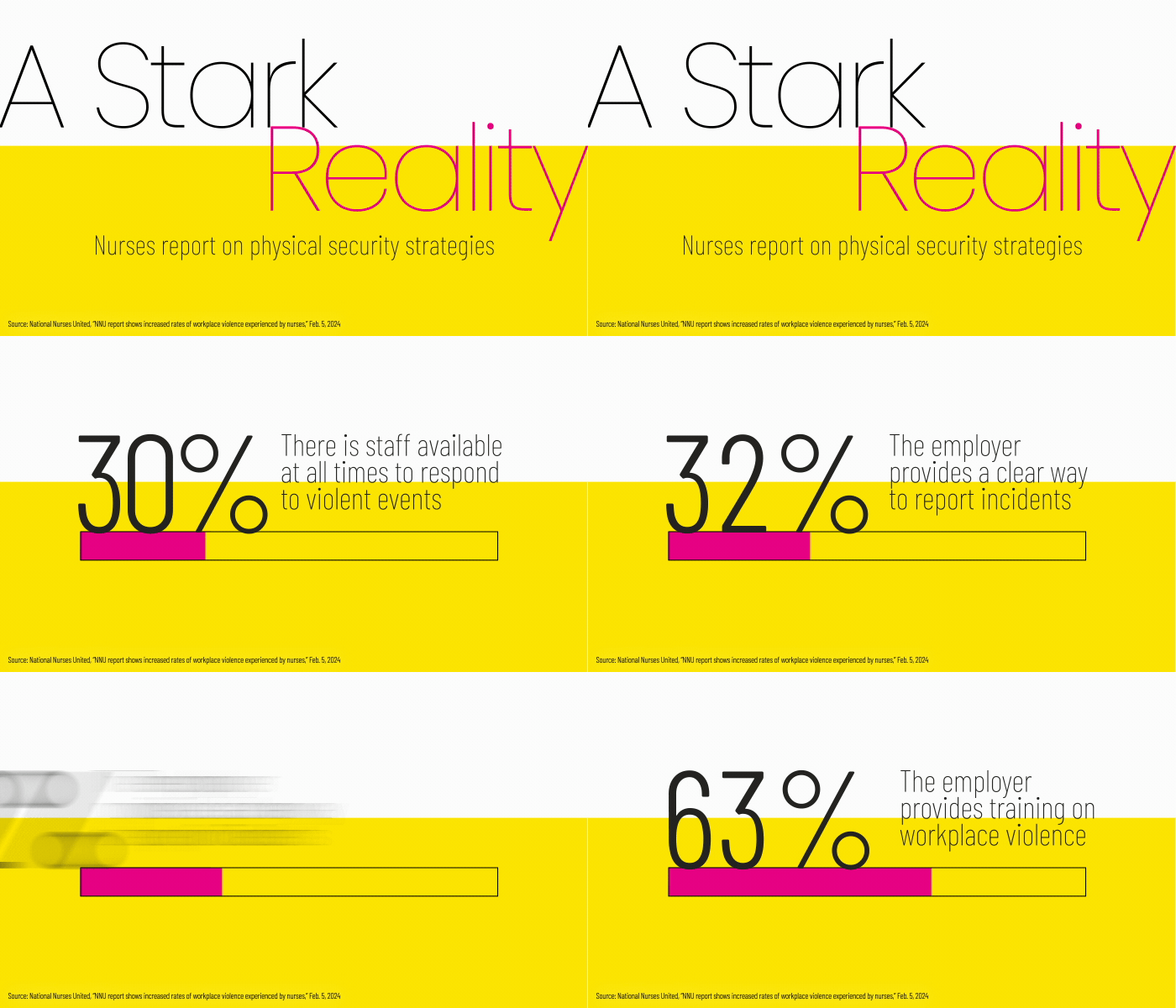

Physical Security Stats


Despite such state-of-the-art approaches, little can be done if a patient suddenly decides to hit a receptionist or throw a bed pan at a physician or nurse.

“The bottom line is, facilities need to consider the actual threats that they’re facing,” Gee says. Organizations may need to tailor their approaches based on their unique needs; a solution that works for a small, rural clinic may not make sense for a large, urban campus.

At PCCI, CIO Albert Karam hopes that the workplace safety decision system can eventually be adapted to serve any healthcare facility. The organization is piloting the solution at the main Parkland Health campus in Dallas.

In the future, once there’s more data and improvements in the predictive model for other applications, Karam says he can imagine it being deployed in emergency departments and a wide range of outpatient settings.

“The ultimate goal is to help staff execute their jobs safely,” Karam says. “We’re just trying to add another effective tool to their safety tool belt.”

Modern Access Control and Monitoring to Protect Patients and Staff

At HealthPRO Heritage, Senior Vice President of IT Josh Scott has similar safety goals for clinical and administrative staff. The South Carolina-based company provides physical, occupational and speech therapy services to schools, hospitals and senior living facilities.

It also owns and operates 16 freestanding pediatric clinics, where Scott recently led the deployment of Verkada security cameras and access control technologies. “We needed a way to ensure patient and staff safety, while also allowing people to come and go,” he says.

Today, front-desk staff members can manage visitors through a Verkada intercom and a built-in video camera at the entrance. Employees can access the buildings and individual rooms at any time using Verkada key fobs, which are programmed according to the restrictions in place at each facility. IT teams can manage the cloud-based system remotely, either from headquarters or with a mobile app.

“There are time stamps and audit logs, so we have records of when people fob in, and we can control which staff are able to get into which rooms,” Scott says.

Interior camera feeds are also part of the system, offering live views of corridors, entrances and exits. Additional cameras in certain treatment rooms provide private monitoring capabilities to facility directors.

Fortunately, Scott says, the only serious incident the organization has experienced since installing the new system was an after-hours break-in at one of the facilities.

“We pulled the footage straight from the Verkada panel and emailed it to the police,” he says. “It really couldn’t have been any easier, and they wound up catching the suspect in the end.”

Photography by Trevor Paulhus