





Close

New Workspace Modernization Research from CDW

See how IT leaders are tackling workspace modernization opportunities and challenges.

Feb 25 2026
Patient-Centered Care

Q&A: Nemours Children’s Health Expands Pediatric Care at Home

Christopher Beaty, vice president of operational innovation at Nemours Children’s Health, shares how providers can launch new services with thoughtful design.

Through telemedicine and hospital-at-home programs, healthcare organizations have been expanding their services to provide quality patient care outside of hospital walls.

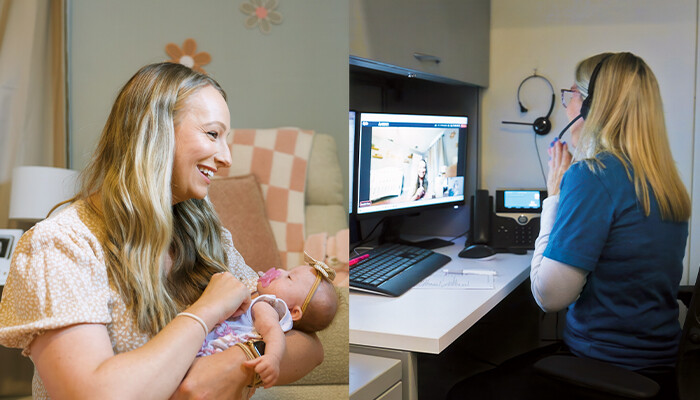
The benefits aren’t just for adult patients; pediatric care is also transforming care delivery for children and their caregivers. Last year, Nemours Children’s Health launched “Advanced Care at Home,” a program for patients who are medically stable enough to go home to heal but still receive virtual care supported by technology and a round-the-clock clinical operations center.    

“We have to challenge the status quo — not only in adult health systems but also in pediatrics — to think differently,” says Christopher Beaty, vice president of operational innovation at Nemours Children’s Health. “We need to accelerate the use of virtual care and infrastructure because the nursing shortage isn't going away, the physician shortage isn't going away, and the surgeon shortage isn't going away. We have to figure out a way to be innovative.”

Beaty tells HealthTech how Nemours Children’s Health stood up the program and is transforming care delivery that’s not confined to inpatient-outpatient definitions.

Click the banner below to discover the building blocks for a secure and efficient infrastructure.


HEALTHTECH: Why did Nemours Children’s Health want to provide Advanced Care at Home?

What we know is that kids heal better at home, for various reasons. Kids do better because they're eating their own food; they're sleeping in their own beds; they're interacting with their siblings and family members; they're more mobile — all of these things matter for the physical and mental well-being of every child. For parents, the burden of having a child in the hospital is quite overwhelming, and that stress can be beyond extreme.

The discussions about the development of Advanced Care at Home came about a few years ago as we were working through the development of an inpatient model of care. We started to pivot and think about it more as a continuum-of-care model, not just inpatient versus outpatient. We had redefined care delivery to focus on patients who were medically stable enough to go home with the virtual infrastructure that we could provide.

Advanced Care at Home is a virtually based, technology-enabled program that operates out of a centralized, 24/7 clinical operations center that we have housed within the Jacksonville, Fla., main campus. It can be offered to a hospital patient who is deemed medically stable but still requires some level of continued clinical support that's holding them back from discharge. With this program, we have the capability to customize not only the amount of virtual clinical support, but also the technology that's needed to support the patient within the home.

EXPLORE: Remote monitoring can help improve care for chronic-disease patients.

HEALTHTECH: How did you collaborate with your IT teams to launch this program? And how are you making sure that end users are using the tech in the right way?

There’s always complexity on the back end. What we didn’t want to do was transfer that into the home for a patient. Our primary focus and goal was to simplify the process for families. We partnered with our IT team to build out the existing infrastructure within our electronic health records system; we utilize Epic. Our families communicate with us using Epic MyChart. It wasn’t anything different than what we would use for standard discharge processes. And if families didn’t have the right tools, we could provide them with what they needed.

We've had a mature virtual infrastructure focusing on inpatient care at Nemours Children’s Health for several years. We have a command center at our Orlando, Fla.-based hospital where we have paramedics or technicians and virtual nurses who are providing clinical oversight of every inpatient within our brick-and-mortar hospital. We learned from that infrastructure to shift into the outpatient world, and because of that, we could accelerate the process to reach patients in the comfort of their own home.

Christopher Beaty
When you have a mature infrastructure that can adapt to change, you can more easily accelerate a service that may be considered new and innovative.”

Christopher Beaty Vice President of Operational Innovation, Nemours Children’s Health

I’ll give you a patient example: Within our neonatal intensive care units, there are some babies who may have a medical or surgical complication that requires advanced support. Once they're stable enough to get over that immediate, acute problem in our NICU, they have to learn to feed and grow. If they can’t eat, they are often burdened with a hospital stay to learn to do so. In this case, we provide families the education they need to use a scale and a feeding pump, and we can provide the tools they need to feed the baby at home.

We've seen some impressive outcomes already. We're lowering the length of stay for this patient population, and we’re keeping them home and safe. They're not having to come back to the hospital unnecessarily because of a technology problem or a feeding tube problem. We can provide proactive support, and families don’t need to travel back and forth for care.

HEALTHTECH: What has the feedback been for this program from patients and their families? How are providers responding to this workflow?

The families are loving this, and we’ve seen very high family satisfaction scores since we launched in 2025. They’re saying, “Without this program, we would have otherwise had to go to A, B and C for additional support,” and that A, B and C might mean reaching out to various stakeholders to help provide clinical support or coming to the emergency department for support that we could have otherwise given using technology or virtual support.

We’ve also found that our providers’ workload is somewhat decreasing, because we can customize the number of virtual nursing and provider visits to meet the clinical needs of the patient. This proactive approach in daily or weekly connections with our nurses is avoiding the sudden escalation of needs that patients have in a home setting. So, our providers are knocking down the door to enroll their patients in this program, because we're seeing not only the benefits for our patients and families but also for our specialty service lines as well.

HEALTHTECH: What's next for the program?

We've extended our reach in Florida. We have patients as far north as Pensacola and as far south as Miami. That's what's special about this customizable virtual approach: We can reach families in the most rural settings, as long as they have access to internet support, but we can even provide support with those systems as well.

We’ll continue to expand in Florida, and then, because our organization provides care in multiple states, we have another stand-alone pediatric hospital in Wilmington, Del., and we want to expand our service in the Delaware Valley. That includes reaching patients who may be in Delaware, New Jersey, Pennsylvania or Maryland. 

In 2026, as we expand our care model, we want to make sure geography is not a challenge because we have a strong virtual infrastructure.

Click the banner below to sign up for HealthTech’s weekly newsletter.


HEALTHTECH: What advice do you have for other healthcare organizations that are interested in opening service lines that make access to care more available to their communities?

At Nemours, we’ve invited experts from around the country to share what they’ve done to develop at-home clinical models of care. We really do believe that we are in uncharted territory, and we think that Nemours is strategically positioned to lead the charge in helping to redefine how pediatric care is delivered. Oftentimes, adult-focused systems lead the way, and then pediatric systems follow suit. We want to leverage the existing structures to develop a consortium of experts to help define a pathway to care for patients where they can heal best.

Communicate and collaborate with team members from around the country that are doing this work and doing it really well. I think we have incredible opportunities to strengthen numbers to help not only innovate with clinical care, but also in other avenues with technology partnerships. A major challenge with technology and pediatrics is, sometimes a solution that is geared toward adults doesn’t really work for pediatric patients. We end up having to fit our pediatric model within an adult-centric system. So, we think we have the opportunity to bring people together to help more clearly define that problem.

Don’t overcomplicate new programs for your internal technology team or patients and families.

When you have a mature infrastructure that can adapt to change, you can more easily accelerate a service that may be considered new and innovative. It’s also crucial to have a leadership support structure as well. Our leadership pushes us to think creatively, to meet patients and families where they are and where the care needs to be, at the right place, at the right time. If that means in the comfort of patients’ homes, our administrative teams are focused on supporting us to create a model to do just that.

jacoblund/Getty Images