



Close

New Research from CDW on Workplace Friction

Learn how IT leaders are working to build a frictionless enterprise.

May 26 2026
Patient-Centered Care

Behind the Scenes of Houston Methodist’s Smart Hospital Campus

The construction of a new hospital gave Houston Methodist a chance to create care models supported by the latest healthcare technology innovations.

In 2021, when Houston Methodist leaders were setting the design vision for Cypress Hospital, they had to predict the future.

They knew they wanted to equip the new facility along Houston’s rapidly growing U.S. 290 corridor with state-of-the-art technology to improve patient outcomes and clinician experiences. But Cypress wouldn’t open until 2025, leaving a four-year window in which technology would continue to evolve.

“We said, ‘OK, what do we think will have matured by the time this hospital opens?’” says Chief Innovation Officer Roberta Schwartz. “And then we trialed those technologies at our other facilities.”

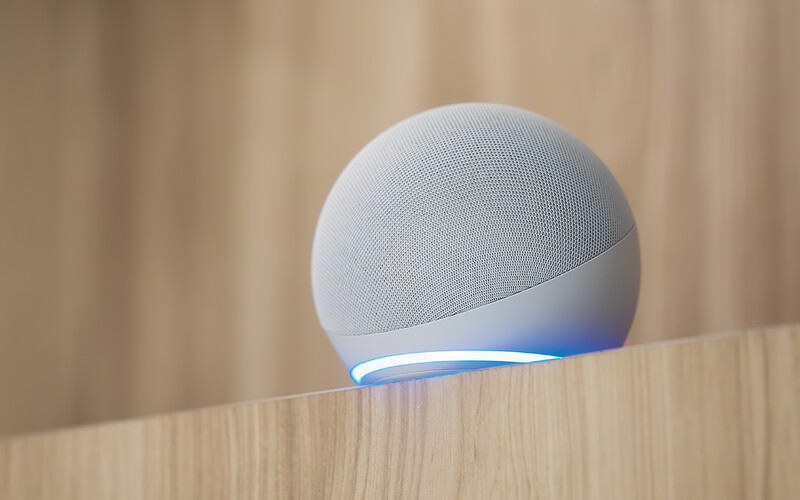
As a greenfield campus, Cypress offered Houston Methodist a blank canvas. Instead of wrestling with aged heating and cooling systems, the organization gave each room its own climate controls that patients can trigger via their bedside Amazon Alexa. And while an older facility would require a major renovation to install new wiring and connectivity infrastructure, Houston Methodist built Cypress with flexible walls that make it simple to trial emerging technologies, paving the way for large video displays, advanced cameras and whatever comes next.

Click the banner below to find out how the smart care continuum improves clinical outcomes.


“Designing a new hospital created opportunities to embed reliability, security and scalability into the building itself, making Cypress a template for future hospital projects rather than a retrofit constrained by legacy systems,” says Jim Francis, CTO and vice president of IT and shared services at Houston Methodist.

The result is a hospital that not only supports today’s most advanced healthcare technology but also will adapt as new solutions transform the industry. Instead of testing solutions at other sites and then deploying them at Cypress, Houston Methodist has flipped that dynamic, treating Cypress as an innovation lab where new projects are validated before they’re rolled out across the eight-hospital network.

“The clinicians and staff at Cypress have a level of ‘yes’ to technology that is amazing,” Schwartz says. “When we’re trialing something new, they get so excited. They’ll say, ‘We go first. We’re the innovation environment.’”

Reducing Friction With IT at Houston Methodist’s Cypress Hospital

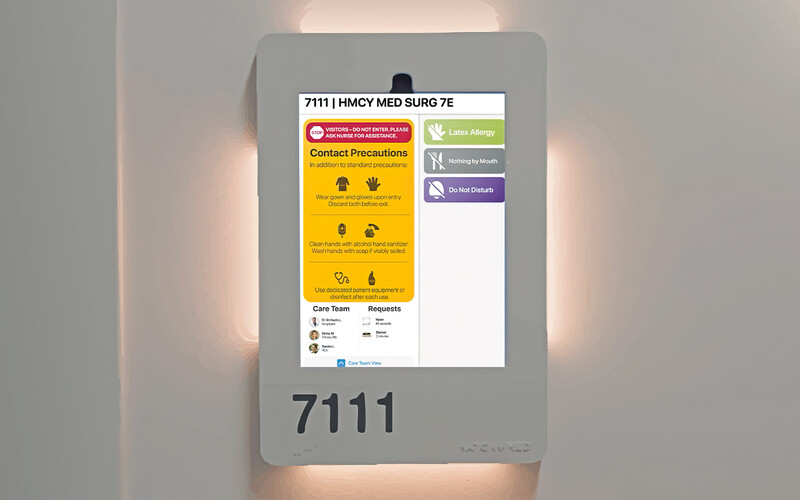
When visitors, clinicians and staff enter a patient room, the first thing they see is digital signage that provides basic patient information and instructions instead of a whiteboard or a folder full of laminated placards. The digital signage, like many of the hardware solutions at Cypress, integrates with the hospital’s Epic electronic health records system, ensuring that clinicians always have access to the latest patient updates.

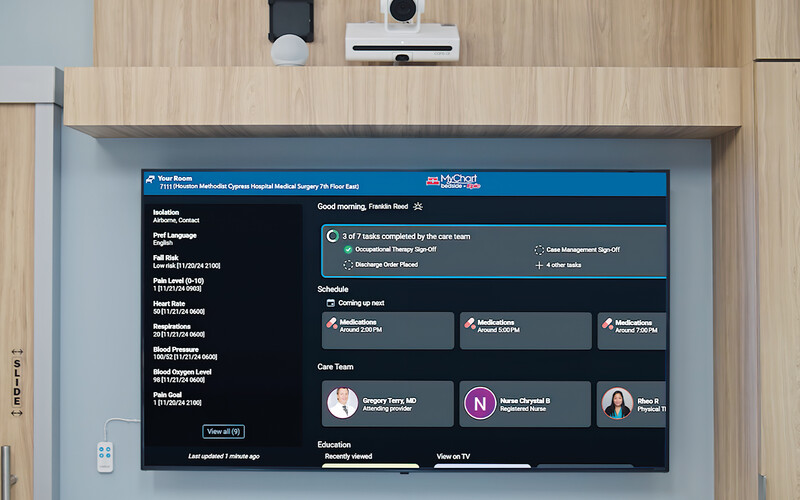
Inside the room, a patient might be on a video call with family or a specialist at another site, enabled by a 65-inch TV and virtual care cameras from Care.ai. Because these peripherals were included in the hospital’s design, Houston Methodist could outfit each patient room with standardized technology, unlike other campuses, where some rooms have smaller screens or lack cameras.

Patients use their Alexas not only to control their room temperature and lighting but also to call for assistance. When working with patients, clinicians use new Ergotron medical carts, as well as Lenovo and Apple endpoints. Nurses carry Apple iPhones equipped with a secure messaging app that allows them to communicate about patient care without violating privacy regulations.

READ MORE: The connected care continuum enhances patient care across settings.

All of this technology is supported by a highly available, segmented Cisco network designed to support a large number of connected devices and advanced virtual care technologies, with clear separation between clinical systems, Internet of Things and patient devices, telemedicine and guest traffic. Houston Methodist IT leaders are currently evaluating the most promising use cases for the hospital’s private 5G network.

“The hospital leverages secure enterprise infrastructure and cloud environments to support its extensive application ecosystem,” Francis says. “Because this was a new facility, we were able to design the network from the ground up, treating it like critical infrastructure rather than an add-on.”


Pull Quotes


Cypress Hospital’s New Nursing Model

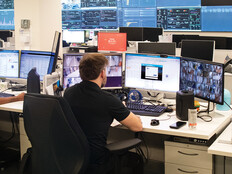
Cypress’s setup supports a robust virtualized nursing program. During the COVID-19 pandemic, many hospitals experimented with centralized virtual nurses who remotely walked patients through admissions, discharges and transfers. Houston Methodist uses a less common “paired” model, with virtual nurses assigned to specific nursing units. Nurses rotate between the floor and a virtual command center every few days, which helps build rapport with patients, Schwartz says.

“The concept is that you want virtual clinicians to still have that hands-on experience and not get so far removed from patients that they forget what it's like to be at the bedside,” she adds.

Lisa Cao, who works as both a virtual and bedside nurse at Cypress Hospital, says the model helps nurses complete admissions and discharges more efficiently, which both improves the patient experience and frees up beds more quickly for patients who may be waiting in the emergency department.

“As a bedside nurse, it’s very busy, and you have to multitask with different patients,” Cao says. “Before we had telenursing, it was really hard to get the admissions and the discharges done in a timely manner. Other tasks would come up, and it wasn’t always the highest priority.”

Cao notes that virtual nurses also facilitate family communications and answer questions about plans of care. Although some patients are apprehensive about the technology, Cao says the large TV screens — combined with the fact that virtual nurses rotate on and off the floor — tend to put patients at ease. An indicator light also turns on anytime room cameras are active, letting patients know if they are being monitored, she adds.

“When they see somebody they’ve already worked with on the TV, that tends to be a little bit more welcoming,” Cao says.

Innovation to Improve Patient Outcomes and Clinician Experiences

Houston Methodist continues to push boundaries with its technology, but the focus remains on improving patient outcomes and clinician workflows rather than on the IT systems themselves.

For example, Cypress Hospital now supports a virtual rapid response team. Most hospitals have rapid response teams that rush to the bedside when a patient’s condition is deteriorating, but Schwartz says that these teams can take up to 10 minutes to reach rooms in large facilities. Response times are delayed even more when multiple calls stack on top of each other, she says. 

“Now, when a rapid response is called, our virtual rapid response person will get online to find out what is happening, usually within 20 seconds,” Schwartz says. “They then immediately start putting in new orders for lab work or medications.”

Houston Methodist leaders are already back in prediction mode, scoping out the next several years of healthcare technology to continue advancing care at Cypress and beyond. “It’s amazing to see how far a hospital can come,” Schwartz says.

Photography by Annie Mulligan