The loss of network connectivity is a major concern for hospitals and other healthcare providers. Without a network that connects clinicians, staff and devices, communication among doctors, nurses and other care providers can be critically disrupted. For example, the transmission of lab results and radiology images may be slowed or altogether halted, while coordination among emergency medical teams is hampered.
Without digital connections, care providers must turn to analog operations and manual processes while continuing to deliver patient care. Many healthcare organizations already have disaster recovery plans on paper, but when a real event hits, these plans are put to the test. In many cases, staff on the overnight shift — who regularly work through planned system upgrades — are more familiar with downtime procedures, but others may struggle without their familiar digital tools. This gap in readiness, more than any single point of technology failure, may be what determines whether a hospital stays operational or struggles to deliver effective care.
Click the banner below to learn more about how organizations can improve their clinical care resilience.
Manual Processes, Communications and Staff Preparedness Are Foundations of Healthcare Disaster Recovery
The ability to apply alternative tools, workflows and staff knowledge are essential to healthcare disaster recovery. Before any organization evaluates its backup connectivity, it should conduct a business impact analysis to identify essential functions that must continue when systems go down. Next, it should develop a plan to support these functions manually. This plan requires details such as what paper forms will be needed during network downtime, what additional staffing is required and how clinical information will move without a network (including options such as runners between departments, call lists, or even legacy tools like pneumatic tube systems where they may still exist).
DISCOVER: Healthcare’s digital future depends on network resilience.
Without a comprehensive, clearly defined operating model, lost information and communication gaps create risks to quality of care as well as the potential for unrecoverable loss of significant revenue. The operating model needs to account not only for how the organization will function during the outage but also for the activities, resources and timing required to recover after an outage. If downtime is extended for a significant period, simply assuming that delivery staff will backfill orders, results, charges and supporting documentation is unrealistic. Additionally, if downtime information capture, quality assurance statistics and related processes are not formalized, the information needed to reconstruct what care was delivered and what is chargeable may not be available.
Backup Connectivity Options for Healthcare Network Disruptions
Once a hospital has established the manual processes it will follow during a disruption, it should focus on arranging for backup network connectivity to serve as a tool that shortens the gap between downtime and limited normal operations. Among the options it should consider for this connectivity:
- Cellular carrier deployments. Cellular service providers can bring in mobile equipment, such as truck-mounted antennas or portable network hardware, to create thousands of Wi-Fi and cellular connections at a hospital. These solutions scale well for large facilities and often come with a cost advantage: Many carriers charge little or nothing for the standby capability itself, billing only when connectivity is used during a disruption. Even better, these costs are frequently reimbursable through business interruption insurance.
- Satellite-based connectivity. Services such as Starlink can spin up quickly and don't depend on terrestrial infrastructure. This connectivity is especially helpful when a wider regional outage takes multiple carriers offline at once. Organizations must pay a monthly fee regardless of whether they use this service, and its capacity may be better suited to smaller facilities than to a hospital campus with tens of thousands of daily connections.
Click the banner below to discover how high-quality care delivery starts with the right foundation.
Neither cellular nor satellite options work everywhere in every hospital. Shielding (used in places such as radiology departments), structural interference or heavy equipment can block both satellite and cellular signals. Wired equipment such as signal boosters may be needed to ensure connections where they are needed. Manual processes are even more important for these areas.
Often a layered approach can help healthcare organizations address their connectivity needs during a disruption. A primary backup connectivity option can be paired with manual procedures to maintain operations while normal network service is restored.
Testing Your Healthcare Disaster Recovery Plan
Healthcare IT teams should understand that having a contract with a connectivity provider is not the same as being prepared for a disruption. They need to know how long it takes a provider to deploy equipment after a request, what that response looks like during a regional disaster affecting multiple facilities and what it costs.
READ MORE: Organizations must brave the new world of cyberthreats with AI.
Further, internal teams must be prepared by testing backup and recovery plans and ensuring that each staff member understands the necessary procedures during downtime. These steps must be taken in advance; waiting until an actual outage to have staff members review a memo is too late.
Compliance adds another layer. Facing the pressure of an outage, staff may improvise and take steps such as using a personal cloud service, which can create HIPAA exposure. Downtime and data-handling expectations should be part of standard annual training, not something introduced for the first time during a disaster.
Preparation Is the Real Differentiator
Healthcare organizations that are able to maintain essential operations during a disaster are not necessarily those with the most sophisticated backup technology. Success requires not only effective IT recovery planning but also thorough testing of those plans and proper staff training on how to carry them out.
Disaster recovery planning has traditionally been led by IT teams. Involving clinical and operational leaders in the planning process helps ensure that the organization has the right priorities and that investments in backup connectivity align with clinicians’ needs. Ultimately, an effective plan can help ensure that patients continue to receive the care they need, even when systems experience an outage.
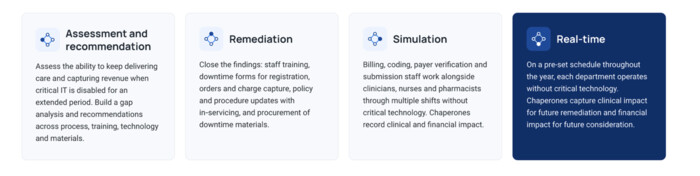
A comprehensive framework for assessment, remediation and downtime practice can be the key to survival in an extended downtime event.
Source: CDW
A strategic partner can help healthcare organizations strengthen their operational readiness. A partner with deep experience in the healthcare industry can provide the technical expertise needed to establish network redundancy and failover, while also developing downtime playbooks and providing essential staff training.
This article is part of HealthTech’s MonITor blog series featuring analysis and recommendations from CDW experts.