



Close

New Research from CDW Explores AI and Cybersecurity

Learn how AI is helping IT teams manage risk and improve resilience.

Oct 21 2026
Management

Q&A: Cleveland Clinic Grounds Tech Change in Reliability and Scalability

Sarah Hatchett, senior vice president and CIO at Cleveland Clinic, discusses change management and ongoing digital transformation in healthcare.

Across industries, generative and agentic artificial intelligence seem to dominate headlines, even in healthcare, which was once thought of as a laggard in adopting new technologies. 

Although many healthcare organizations are at the forefront of innovation, it’s crucial to tie modern solutions to clear business problems and to avoid newness for the sake of appearances. 

“Healthcare doesn't need more technology for the sake of technology. It's all about scalable, reliable solutions that really improve care and create enterprise value,” Sarah Hatchett, senior vice president and CIO at Cleveland Clinic, tells HealthTech.

She talks about how Cleveland Clinic prioritizes reducing friction for patients and clinicians and why stakeholder alignment is key to an IT project’s success.

Click the banner below to find out how to take advantage of data and AI for better healthcare outcomes.


HEALTHTECH: Amid a challenging healthcare landscape with financial and workforce constraints, how has Cleveland Clinic addressed these concerns through technology and through process updates? What has worked for your organization?

HATCHETT: It's important that when you're assessing the priority and utility of different technology solutions that you're mapping it to important business problems to solve. It’s important for organizations to ask themselves several questions: How do we address the largest problems to drive the most amount of impact? We address them by thinking about how to remove friction from work. Some of our biggest wins involve pairing tools with process redesign, challenging current assumptions about how healthcare is delivered today. Our goal is to reduce the administrative burden on our caregivers to allow them to spend more time on patient care.

Is there a way that we can actually bring about true digital transformation? Like many other providers, we've explored technologies such as ambient dictation and AI clinical decision support, and automation in revenue cycle and back-office functions. In doing so, we are evaluating operational platforms and analytics that can help us better manage capacity utilization and resource constraints to optimize.

Human-centered care is still the primary model of care delivery, so being able to connect the dots between the patients who need to be seen and those who have the right type of availability to meet their needs is really important.

At a high level, health systems should be disciplined about use cases: Start with a real clinical or operational pain point, make sure they have a line of sight to what those outcomes are, figure out how to transform the workflow, and then apply technology. Our success has come from combining process redesign with targeted technology investments that reduce caregiver burden, improve patient access, strengthen safety and quality outcomes and help us operate more efficiently in an increasingly constrained healthcare environment. 

HEALTHTECH: How are you evaluating new solutions?

HATCHETT: At Cleveland Clinic, we ask, can it scale across the enterprise in a system as complex as ours? We believe that anything that we do needs to be done in a standard way. Consistency in both the caregiver and patient experience is important, so we would not want to pursue something that's just a one-off solution or doesn't seem durable enough to scale. 

Also, we ask, does this technology integrate with the clinical workflow? I think a lot of these AI solutions may speak to a business problem but could end up creating more friction for caregivers. We evaluate how well a solution fits into clinical and operational workflows, the amount of change management required and whether caregivers are likely to embrace it.

The best solution isn't creating an innovation theater, lab or something that's just happening in a space that's separate from operations, but it’s technology that is more clinically and operationally relevant, that helps to create repeatable patterns that move it out of that isolated pilot phase. We prefer targeted pilots with clear success metrics before broad deployment. This allows us to validate assumptions, measure outcomes, gather user feedback and refine workflows before making larger investments.
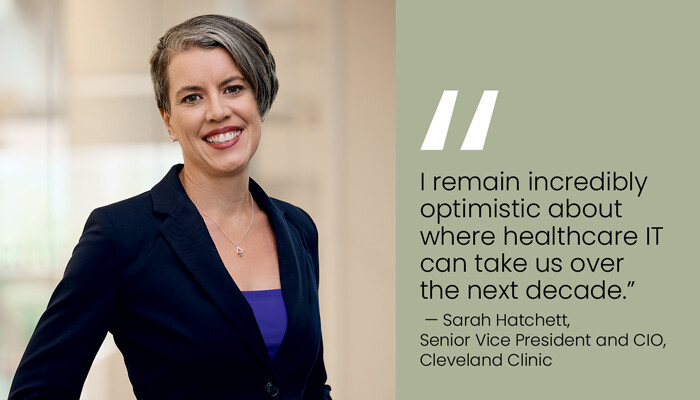

Sarah Hatchett


HEALTHTECH: How do you ensure appropriate stakeholder involvement when implementing major IT initiatives? What helps to improve collaboration between clinical and IT departments?

HATCHETT: Alignment before we make a technology decision is key. Because we operate in a complex enterprise, finding that right executive sponsor can be challenging, especially for technology capabilities that speak to multiple roles or workflows.

I'll give you an example. One thing we're exploring is the use of video in the inpatient room to do things like AI-enabled fall detection and virtual nursing. That capability alone can be supported by physicians, nurses, operations, food service, the list goes on — even patient experience. There's a whole host of stakeholders that could benefit from that type of technology, but it's really important that you have a champion who is going to also help you pull all of those stakeholders together for the right level of support that's needed.

In addition to sponsorship, it’s important to define success. Do we have clinical champions who can provide subject matter expertise in change management communication out to the different end users? It’s important to keep focused on measurable outcomes and have someone who's able to share the accountability for the outcomes themselves. Collaboration improves when IT and business teams are aligned around implementation efforts and common outcomes. 

HEALTHTECH: How do you balance the need to innovate quickly with the requirements to maintain highly reliable, always-on systems? How has Cleveland Clinic tackled clinical care resilience?

HATCHETT: In healthcare, reliability is nonnegotiable. It must be there, and further innovation can exceed at a more rapid pace when it's built upon a resilient, strong foundation. What that means for Cleveland Clinic is investing in cybersecurity and infrastructure, disaster recovery and even our network connectivity. It’s all part of creating a safe pathway to test and scale new capabilities.

What's interesting about AI is that there's also this element of clinical care resilience. Where do we embed technology that now becomes part of a clinical workflow, so that if that technology experiences a failure, we can quickly resume from a business continuity standpoint? While downtime is something we hope to avoid at all costs, it can happen, and we must work with our clinical partners to plan. As tools such as check-in kiosks and video technology become more integrated into the care delivery process, we must have back-up plans to deliver care if it is not available.

Click the banner below to sign up for HealthTech’s weekly newsletter.


HEALTHTECH: How is the organization preparing its workforce across IT and clinical teams to adapt to rapid technological change, particularly with the rise of AI?

HATCHETT: Our workforce needs both literacy and confidence, and what I mean by that is you need to understand not only what AI can do and what it can't do, but also where it is appropriate to use it and where we need human judgment to remain central. So, while we’re thinking about ramping up AI education and enablement, we’re also making sure that there’s transparency about how these tools work. In addition, as they’re rolled out, we want to have continuing engagement to ensure our caregivers understand the workflows and why it’s critical to have humans in the loop.

The goal with that is not to make everyone a technologist, but to give our teams a level of understanding for how the technology can help them, helps generate great new ideas, while also helping them become part of the governance process of AI.

HEALTHTECH: What do you think will be the top healthcare IT priorities for the rest of 2026 and into 2027?

HATCHETT: I'll just put AI all in a bucket. It's real, it's here to stay. I think that we're seeing a lot of promising use cases that deliver measurable value, so that will continue to be a huge part of the agenda.

Cybersecurity and resilience are still important for healthcare, as the industry is still a target. We have to continue to double down and stay one step ahead.

In addition, platform rationalization, cost discipline and sustainability continue to be important for the healthcare industry as a whole. How do we look at being good stewards and continuing to create an environment where we're both making investments and managing costs? 

I'm also seeing more interest in interoperability and data and automation, especially as providers and the federal government put inspiring visions forward for how we can work together across the industry. There's a number of programs that we're excited about because we think it's going to be truly transformational.

I believe we're entering one of the most exciting periods in healthcare history. For the first time, we have the opportunity to combine clinical expertise, data and AI in ways that can fundamentally improve patient outcomes, caregiver experience and access to care. The goal is to create a healthcare system that is more predictive than reactive, more personalized than standardized, and more accessible than ever. That's what makes this moment so exciting and why I remain incredibly optimistic about where healthcare IT can take us over the next decade.

Photography by Angelo Merendino