


Close

New Research from CDW on Workplace Friction

Learn how IT leaders are working to build a frictionless enterprise.

May 12 2026
Data Analytics

How Senior Living Communities Use Data to Improve Care and Operations

Data analytics allow senior care organizations to make smarter decisions.

When leaders and staff at Frasier, a senior living community in Boulder, Colo., want better visibility into their operations, they can now pull up Microsoft Power BI dashboards.

They can quickly view resident census data, financial metrics, marketing pipelines, dining statistics, IT help desk trends and more, all aggregated in a Microsoft Azure data lake.

Senior IT Director Jeff Puckett led an enterprise architecture initiative that included the data analytics project, which went live in 2025. Puckett joined the 500-resident, 20-acre community in 2017 and has steadily modernized its IT infrastructure and enterprise applications ever since.

“We've already seen better and more informed decision-making from our leadership team based on the data,” says Michael Maurer, Frasier’s senior network administrator. "We can now understand what’s happening in each department from a financial and resident perspective.”

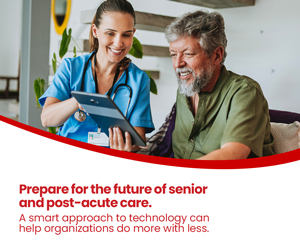
Click the banner to learn how tech eases operational challenges and improves resident experiences.


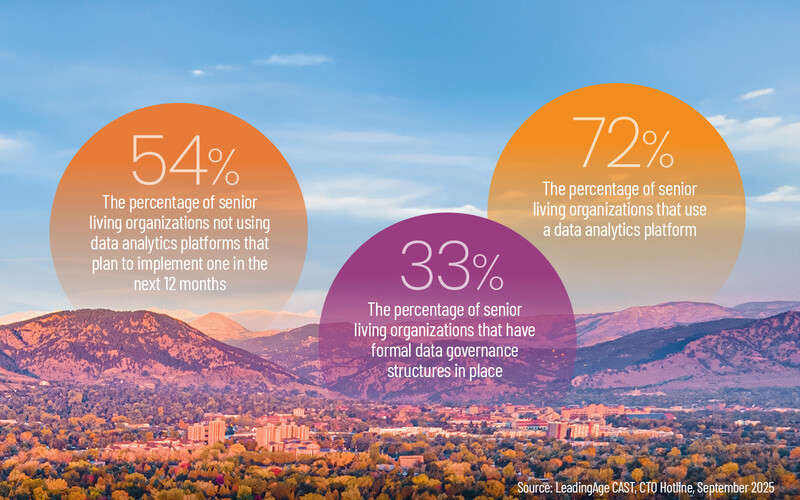
An increasing number of senior care organizations are supercharging their operations with data-driven approaches. The benefits include improved resident experiences, better quality of care and increased staff efficiency, says Scott Code, vice president of the Center for Aging Services Technologies at industry association LeadingAge.

For years, many organizations focused on implementing key enterprise applications, such as electronic health records systems, financial and HR platforms, safety technology and resident engagement tools. With systems in place, senior living communities realized that they had vast amounts of data that they should use to guide their operations, Code says.

Some use analytics tools built into individual applications. Some are centralizing data into data lakes or warehouses so they can build department-level reports that their existing systems can’t provide. And some are integrating their data to get more comprehensive views of their residents and operations.

“Ten years ago, people would be like, ‘We’re finally getting an EHR,” Code says. “Now, they have to figure out, ‘How do I take all this data, bring it all together and start making smart decisions based on what’s happening in my organization?’”

In fact, “data analytics tools” ranks as the top technology investment priority today, surpassing information and communications technology infrastructure for the first time, a 2025 LeadingAge CAST survey found.

READ MORE: Improve the flow of data in senior care.

Frasier’s Focus on Building a Data Foundation

When Puckett joined Frasier, he inherited a barebones IT environment with one rack of servers running VMware and no standards for computers, printers, servers or mobile devices.

He got to work standardizing the organization on HP desktops and Microsoft Surface laptops, replaced a legacy phone system with Voice over IP, upgraded to Fortinet firewalls and built an eight-rack data center powered by HPE servers and storage. He replicated the on-premises environment to Microsoft Azure.

In 2024, Puckett and his team began modernizing enterprise applications with new cloud-based her, accounting and financial software. At the same time, they saw an opportunity to adopt data analytics by consolidating data from new and existing applications into an Azure data lake and deploying Power BI dashboards.

“We now have good information to drive business decisions,” Puckett says.

The IT team evaluated each application to determine how to transfer the data and how frequently it needed to be refreshed. Before building the actual dashboards, the IT team brainstormed with department leaders and designed prototypes.

"We looked at all of that very early in the process," Puckett says. "What information do you need to see to help you make informed decisions about running your department as a good steward? Then, we mocked up the dashboards like cartoons.”

The Power BI dashboards went live in October 2025 and are already making an impact. On the IT side, help desk ticket volume from staff and residents has increased 150%, from 2,000 a month in 2021 to 5,000 a month now. The dashboard breaks out after-hours tickets, which helps Puckett evaluate whether the 24/7 operation has enough IT coverage on nights and weekends, he says.

On the care side, the organization tracks call volume and response times from the facility’s nurse call system and directly manages if key targets are not met. That way, care teams can improve services and ensure that residents are fully supported.

The data strategy has also paved the way for automation. When a new resident moves in, staff currently enter the same information, such as name, phone number and apartment number, into more than 20 applications, including the EHR, IT ticketing, marketing, dining and facilities maintenance. Each manual entry creates opportunities for errors, Puckett says.

The team is now building what it calls “census automation,” using Azure Service Bus to orchestrate application programming interface calls that push resident data across applications automatically, with Power Automate handling many workflow steps, Maurer says.

“Rather than entering that information 20 times or more and potentially having errors, we’re automating that flow,” Puckett says.

EXPLORE: How are senior care organizations evolving with AI.

RiverSpring Living Uses Point-of-Care Data to Improve Services

In New York City, RiverSpring Living has adopted several point-of-care technologies that capture data and improve care and operational efficiency.

It’s part of a digital transformation initiative launched in 2020 through donor-gifted funding for technology projects. An IT steering committee set three criteria for every investment: improve residents’ quality of life and care, make staff more efficient and deliver a financial return, says CIO David Finkelstein.

The 110-year-old, post-acute senior care provider operates a hybrid environment with a small on-premises data center running Nutanix hyperconverged infrastructure on HP servers and has been steadily migrating applications to the cloud, such as Microsoft 365 and the provider’s EHR.

RiverSpring Living deployed automated vital signs collection carts that record and transmit blood pressure, respiration, temperature, pulse and oxygen levels directly to the EHR, replacing a manual process that was time-consuming and sometimes led to incomplete or inaccurate data.

The technology eliminated data entry errors, freed up eight hours a week per nurse and gave clinicians the ability to accurately track vital sign trends and spot changes that might not be visible day to day.

Click the banner below to sign up for HealthTech’s weekly newsletter.


"We can generate reports for the medical team that this person's blood pressure is trending up over the past three or four weeks, or this person's oxygen level is trending down, and we should have some medical interventions,” Finkelstein says.

Another project is a nurse call system that combines traditional call buttons with wireless two-way communication. When residents press the button, caregivers receive an alert on a mobile device and can speak with the resident. The system tracks interactions and measures response times.

RiverSpring Living’s target is a five-minute response for standard calls and three minutes for emergencies. Since 2021, the organization has processed roughly 300,000 calls and meets response time targets in the high 90th percentile, Finkelstein says.

"If a family member calls and says, ‘Mom pressed the nurse call button 10 times yesterday and no one came,’ we can reassure them with the data, giving them peace of mind and supporting our staff," he adds. "It helps defend the staff and helps families feel confident that we know how to treat our residents."

Today, the organization uses Excel spreadsheets to analyze data. It plans to build a data lake and consolidate EHR, financial and clinical data into a single dashboard. But for now, the data generated by these individual systems is making a difference.  

"All of our goals here are to give the residents the best experience and to provide the healthcare services they need," Finkelstein says.

LEARN MORE: How can AI and automation transform processes for senior care providers.

Courtesy of Unfound Door